If you've spent more than five minutes in crypto Twitter, you've seen the abbreviations flying around: "This L2 is going to flip Ethereum," or "The real alpha is in L3 application chains." But what do these terms actually mean — and more importantly, why should you care as an investor?
The answer is simple: the blockchain layer a project is built on directly determines its speed, cost, scalability, and long-term viability. Understanding the technology stack isn't just academic. It changes how you evaluate every single IDO you invest in.
This guide cuts through the jargon. Whether you just bought your first token or you've been navigating DeFi since 2017, by the end of this article you'll have a clear, practical framework for understanding blockchain layer architecture — and how it translates into real investment decisions.
The Foundation: Why Do Blockchain Layers Exist?
Before diving into each layer, you need to understand the problem they're solving. It's called the Blockchain Trilemma — a concept famously articulated by Ethereum co-founder Vitalik Buterin.
The trilemma states that every blockchain must balance three competing properties:
Security — Protection against attacks and fraudulent transactions
Decentralization — No single entity controls the network
Scalability — The ability to process large transaction volumes quickly and cheaply
The brutal reality? Optimizing for any two of these properties typically forces a compromise on the third. Bitcoin, for example, is exceptionally secure and decentralized — but its base layer processes only around 7 transactions per second. Visa, by comparison, handles over 24,000 TPS. That gap is exactly why blockchain layers were invented.
Rather than forcing one chain to do everything perfectly, the layered architecture distributes responsibilities. Each layer focuses on what it does best, and together they create a system that is fast, safe, and open.
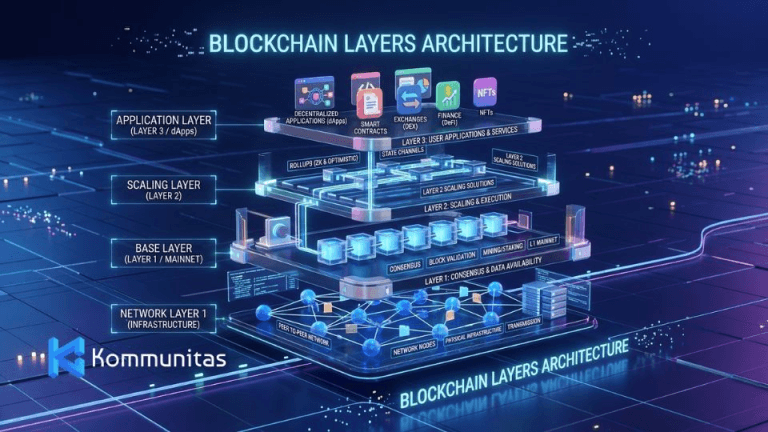
Think of it like a city's infrastructure: the underground electrical grid (Layer 0) powers everything invisibly. The roads and city plan (Layer 1) form the foundational structure. Expressways and subway lines (Layer 2) move traffic faster without rebuilding the city. And the international airports (Layer 3) connect your city to the rest of the world.
Layer 0 (L0): The Infrastructure Beneath Everything
Layer 0 is the most overlooked but arguably most fundamental layer in the stack. It represents the underlying physical and network infrastructure that makes blockchains possible at all — the internet protocols, hardware nodes, and cross-chain communication frameworks that sit beneath individual blockchain networks.
What L0 Does
Enables different L1 blockchains to communicate and transfer data with each other
Provides the base networking, peer-to-peer protocols, and data transmission frameworks
Acts as the "soil" in which multiple blockchain ecosystems can grow simultaneously
Key L0 Projects
Polkadot's relay chain, for instance, allows completely separate blockchains to communicate and share information seamlessly. Without L0 infrastructure, blockchains would operate as isolated islands — unable to share liquidity, data, or users.
Investor takeaway: L0 projects are high-conviction, long-term infrastructure bets. Their value accrues as more L1 chains build on top of them. They are less likely to produce the explosive short-term gains of application tokens, but they form the bedrock of an interconnected Web3 ecosystem.
Layer 1 (L1): The Base Blockchain
Layer 1 is what most people mean when they say "blockchain." It's the foundational network — the core protocol that handles transaction validation, consensus, and data storage directly on-chain.
What L1 Does
Validates and records transactions immutably
Enforces consensus rules (Proof of Work, Proof of Stake, etc.)
Hosts smart contracts and decentralized applications
Maintains the canonical state of the network
The Most Important L1 Networks
L1 chains are where security lives. When you hold ETH, BTC, or SOL, you're betting on the long-term dominance of a base layer network. The trade-off? L1s are inherently constrained. During periods of high network demand — like the 2021 bull run — Ethereum gas fees spiked to over $200 per transaction, effectively pricing out smaller participants.
This is exactly where Layer 2 enters the picture.
Investor takeaway: L1 tokens are typically the core of a long-term crypto portfolio. They benefit from ecosystem growth — every application, L2, and user built on top of an L1 adds value to the base layer. Evaluate L1s by developer activity, ecosystem size, and institutional adoption.
Layer 2 (L2): Scaling Without Sacrificing Security
Layer 2 solutions are protocols built on top of an L1 to dramatically increase transaction throughput and reduce costs — without altering the underlying security of the base chain.
The key insight behind L2 design is elegant: instead of processing every transaction on the expensive, congested main chain, L2 handles transactions off-chain (or in compressed batches), then periodically settles the final state back to L1. The L1 remains the ultimate source of truth and security; the L2 just makes getting there much cheaper and faster.
The Main Types of L2 Solutions
Rollups are the dominant form of L2 today. They bundle hundreds or thousands of transactions together and submit a single compressed proof to L1.
Optimistic Rollups (Arbitrum, Optimism): Assume all transactions are valid by default and only run verification if someone raises a dispute. Fast and cost-effective, but have a withdrawal delay (typically 7 days) while the challenge window is open.
Zero-Knowledge (ZK) Rollups (zkSync, StarkNet, Polygon zkEVM): Use advanced cryptographic proofs to mathematically verify every batch of transactions is valid before submission. Faster finality, higher security guarantees, but more computationally intensive to generate.
State Channels (Lightning Network for Bitcoin) allow two parties to transact unlimited times off-chain, only broadcasting the opening and closing states to L1. Extremely efficient for repeated bilateral transactions like micropayments.
Plasma Chains create smaller child blockchains anchored to L1, periodically checkpointing their state. Well-suited for high-volume applications but with complexity in exit mechanisms.
L2 by the Numbers
The scale of L2 adoption is staggering. As of 2024, there were over 40 L2 solutions within the Ethereum ecosystem alone, with a collective Total Value Locked (TVL) exceeding $46 billion. Average Ethereum gas fees, which once regularly hit $20–$50 per transaction during peak usage, fell to approximately $3.78 in 2025 — a direct result of L2 adoption compressing demand on the base layer.
L2 Comparison Table
Investor takeaway: L2 tokens can offer asymmetric returns, especially early in a new L2's lifecycle. Evaluate L2 projects by: TVL growth rate, unique active addresses, fee revenue, and whether the underlying technology is optimistic or ZK (ZK rollups are generally considered the more robust long-term architecture).
Layer 3 (L3): Application-Specific Chains and Cross-Chain Interoperability
Layer 3 is the newest and most rapidly evolving frontier in blockchain architecture. Built on top of L2 infrastructure, L3 serves two primary purposes: ultra-specific application customization and seamless cross-chain interoperability.
If L2 is the expressway system, L3 is the point where you actually arrive at your destination — the DeFi protocol, the game, the NFT marketplace, the enterprise supply chain tool. L3 allows developers to create application-specific environments with precisely tuned parameters: custom gas tokens, privacy rules, throughput limits, and governance structures — all while inheriting security from the layers beneath.
What L3 Enables
Application-specific blockchains: A gaming studio can build an L3 optimized entirely for in-game transactions with near-zero fees and custom logic — without building and securing an entirely new L1.
Cross-chain interoperability: L3 bridges different blockchain ecosystems, allowing assets and data to flow between chains that couldn't otherwise communicate. Cosmos' IBC (Inter-Blockchain Communication) protocol, for example, had facilitated over $50 billion in cross-chain volume by 2025.
Privacy enhancements: Over 40% of active L3 networks in 2025 had implemented zero-knowledge proof-based privacy features.
The Growth Story
The L3 segment is arguably the fastest-growing area of blockchain infrastructure. Key data points:
Over 35 application-specific L3 projects had launched by 2025, focused on gaming, social applications, and real-world asset tokenization
The L3 blockchain segment is forecasted to grow at a CAGR of 64–85% from 2024 to 2028
Ethereum L3 networks are capable of processing up to 12,000 TPS — dwarfing L1 throughput
Layer 3 solutions reduce transaction fees by up to 70% compared to L1 monolithic chains
Enterprise adoption of L3 solutions rose 45% in 2025, driven by scalability and customization benefits
The Risk You Must Know
Cross-chain bridges — the technology underpinning much of L3's interoperability promise — represent one of the most significant attack surfaces in crypto. Bridge-related hacks resulted in approximately $2 billion in losses in 2024 alone. When evaluating L3 projects, scrutinize the security audits and design of any bridging mechanism.
Investor takeaway: L3 is where the next generation of consumer-facing crypto applications will be built. Gaming projects, social platforms, DePIN networks, and real-world asset protocols are natural L3 inhabitants. This is an early-stage space — higher risk, higher potential reward. Due diligence on the team, tech audits, and the specific L2 they anchor to is critical.
How to Use Blockchain Layer Knowledge When Evaluating an IDO
Understanding layers isn't just intellectual curiosity — it's a practical investment filter. Here's a step-by-step framework for applying layer knowledge to any new project:
Step 1: Identify which layer the project operates on. Is it building its own L1? Deploying a protocol on an existing L2? Creating an application-specific L3? Each carries different risk/reward profiles.
Step 2: Evaluate the layer's security inheritance. An L3 built on Arbitrum (which settles to Ethereum) inherits Ethereum's security. An L1 with 100 validators has very different security properties. The further from a battle-tested base layer, the more you should scrutinize the security architecture.
Step 3: Assess the scalability fit. Does the project's use case actually require this layer? A micropayment protocol built directly on Ethereum L1 is fighting against its environment. The same protocol on Lightning or an L2 makes far more sense.
Step 4: Check ecosystem alignment. Which L1 or L2 ecosystem does the project live in? A project on Ethereum's L2 ecosystem has access to the largest developer community and DeFi liquidity pool in crypto. A project on a smaller L1 may offer more upside but with greater ecosystem risk.
Step 5: Look for interoperability. Projects that can move assets and data across chains are better positioned for long-term growth. Siloed ecosystems lose relevance as the multi-chain future matures.
Case Study: Ethereum's Layer Stack in Action
Ethereum's evolution illustrates the power of the layered model better than any other example.
At the L1 level, Ethereum processes base transactions and hosts smart contracts — the settlement layer for the entire ecosystem.
At the L2 level, Arbitrum and Optimism have absorbed enormous volumes of DeFi activity, enabling users to interact with Ethereum-based protocols for fractions of a cent rather than tens of dollars. Base (built by Coinbase on the OP Stack) brought millions of new users into the Ethereum ecosystem without touching L1 directly.
At the L3 level, application-specific chains are emerging on top of these L2 networks — giving gaming studios, enterprise platforms, and niche DeFi protocols their own optimized environments while remaining anchored to Ethereum's security.
The result: Ethereum's base layer has become more valuable as its ecosystem scales, not less. L2 and L3 growth flows economic activity back to L1 through settlement fees and ETH demand. This is the compounding power of a well-designed layered architecture.
FAQ
Q: Do I need to understand blockchain layers to invest in crypto?
You don't need a deep technical background, but understanding layers gives you a massive analytical edge. When you evaluate a new IDO, knowing whether it's an L1, L2, or L3 immediately tells you what problems it's trying to solve, what its competitive landscape looks like, and what security assumptions it relies on. It's the difference between investing with conviction and investing blind.
Q: Which layer offers the best investment opportunities right now?
Each layer offers a different risk/reward profile. L1 tokens (BTC, ETH, SOL) are typically lower volatility, longer-term holds with deep liquidity. L2 tokens carry higher growth potential as the scaling narrative matures — Arbitrum and Optimism are still relatively early in their adoption curves. L3 tokens represent the frontier: highest risk, highest potential returns, and where many of the most innovative early-stage projects (like those launching on Kommunitas) currently live.
Q: What is the difference between a sidechain and an L2?
This is a common source of confusion. A true L2 inherits its security from the L1 it settles to — if the L1 is secure, the L2 is secure. A sidechain, by contrast, operates with its own independent consensus mechanism and security model, and is only loosely connected to the main chain via a bridge. Sidechains can offer great performance but carry additional trust assumptions that a true L2 does not.
Q: Are ZK Rollups better than Optimistic Rollups?
From a pure technology standpoint, ZK Rollups are considered the more robust long-term architecture because they provide cryptographic proof of validity for every transaction batch, offering faster finality and stronger security guarantees. Optimistic Rollups are simpler to implement and have currently captured more market share (Arbitrum is the largest L2 by TVL). Both are significant improvements over L1 alone — the debate is about which will dominate in five years.
Q: How do blockchain layers relate to multi-chain investing?
The layered architecture is precisely what makes multi-chain investing rational. Rather than one blockchain winning everything, the future is likely a modular stack: a few dominant L1s providing security, a rich ecosystem of L2s providing scale, and thousands of specialized L3 applications serving specific niches. As an investor, diversifying across layers — holding some L1 assets for stability, some L2 tokens for growth, and selectively betting on promising L3 projects — mirrors how the technology itself is designed to work.
Conclusion: Layer Knowledge Is Your Competitive Advantage
Blockchain layers are not abstract computer science — they are the architecture that determines which projects can scale, which will collapse under their own gas fees, and which are building something genuinely durable.
The progression from L0 infrastructure through L1 security, L2 scalability, and L3 specialization is not a linear improvement ladder. It's a modular ecosystem where each layer amplifies the others. Understanding where a project sits in that stack tells you how it generates value, what its competitive moat is, and what risks you're taking on as an investor.
The data makes this clear: L2 TVL has surpassed $46 billion. L3 transaction volumes are scaling exponentially. Cross-chain activity is growing faster than any single-chain metric. The multi-layer future isn't coming — it's already here.
Your next step: Take this framework and put it to work. At Kommunitas — the tierless, community-first crypto launchpad — new IDO projects are launching regularly across L1, L2, and L3 ecosystems. With no minimum staking barrier and guaranteed allocation for every $KOM holder, you can apply your layer analysis to projects at the ground floor, before the market catches on.
Connect your wallet, stake $KOM, and start evaluating the next generation of blockchain projects with the clarity that most investors simply don't have.
The edge is yours. Use it.
References
A Beginner's Guide to Understanding the Layers of Blockchain Technology — CoinTelegraph (November 2025)
What's L1, L2 and L3? A Deep Dive Into Blockchain Layers — Blockchain Magazine (June 2025)
Layer 3 Blockchain Growth Statistics 2026: What's Driving Adoption — CoinLaw (February 2026)
What Is the Blockchain Trilemma? Scalability vs Security vs Decentralization — Phemex Academy (June 2025)
Navigating the Blockchain Trilemma: A Review of Recent Advances — ScienceDirect / Computer Modeling in Engineering & Sciences (July 2025)
Third Layer Blockchains Are Being Rapidly Developed — ScienceDirect (October 2024)
Explore the Layers of Blockchain Technology from L1 to L3 — Block & Capital (September 2025)
Blockchain Trilemma: Decentralization, Security, and Scalability Challenges Explained — Trezor Blog
Crypto Launchpads Capital Requirements Comparison 2026 — Kommunitas Official Blog (March 2026)
Kommunitas FAQs and Platform Documentation — docs.kommunitas.net