
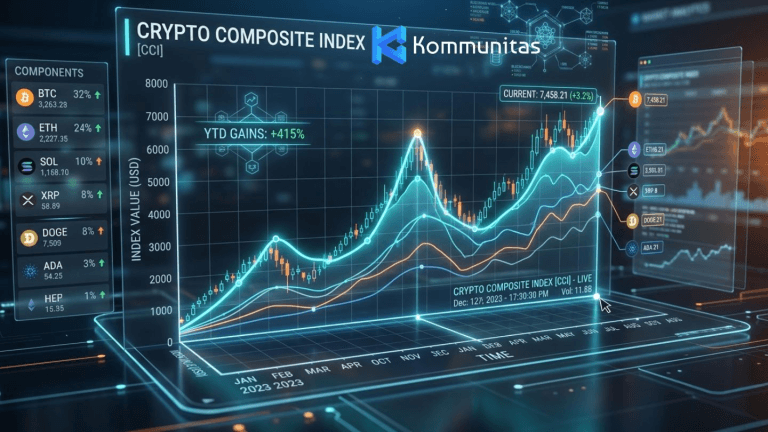
Most crypto investors look at two things: Bitcoin's price and their portfolio's current value. If BTC is up, they feel good. If it's down, they panic. That's not investing — that's gambling with extra steps.
The investors who consistently make better decisions aren't looking at any single coin. They're watching the entire market through a lens called a crypto composite index. It's the same methodology that powers the S&P 500 and the Dow Jones in traditional markets — applied to digital assets. And once you learn how to read it, the noise of daily price swings stops feeling terrifying and starts feeling like useful information.
This guide will teach you exactly what a crypto composite index is, why it matters, which ones actually move the needle for your strategy, and how to use them — whether you're staking $50 or managing a $50,000 portfolio.
What Is a Crypto Composite Index?
A crypto composite index is a single, aggregated metric that tracks the combined performance of a group of digital assets. Rather than following one token in isolation, a composite index gives you a snapshot of the broader market — or a specific segment of it — all in one number.
The concept is borrowed directly from traditional finance. The S&P 500 tracks 500 companies. The NASDAQ Composite covers over 3,000 tech-heavy stocks. These indexes don't just tell you how one company is doing; they tell you how an entire sector or economy is moving. Crypto composite indexes do the same for digital assets.
A well-constructed crypto composite index typically defines itself by three design decisions:
Which assets are included — Top 10 by market cap? Top 30? All DeFi tokens? This determines what part of the market the index represents.
How each asset is weighted — Most indexes use market capitalization weighting, meaning larger assets have more influence. Others use square-root weighting or equal weighting to reduce concentration risk.
How often it rebalances — Monthly and quarterly rebalances are standard, ensuring the index stays aligned with actual market conditions as assets rise, fall, or get replaced.
The result is a number — or a score — that tells you something no single-asset chart can: the overall health and direction of the crypto market.
Why Every Crypto Investor Needs to Watch These Indexes
Here's the uncomfortable truth: if you're making investment decisions based purely on individual token price action, you're flying blind. The crypto market is driven by interconnected forces — sentiment, liquidity rotation, Bitcoin dominance shifts, and macro conditions — that no single token chart can capture.
Composite indexes solve this by providing:
Market Context. A token dropping 15% looks like a red flag in isolation. The same token dropping 15% while the broader market composite is down 25% suddenly looks like relative strength. Context transforms how you interpret price movements.
Sentiment Signals. Certain composite indexes are specifically designed to measure the emotional state of the market — not just price, but fear, greed, momentum, and social behavior. These signals have historically preceded both major market bottoms and dangerous tops.
Benchmark Performance. If your portfolio is up 40% but the top-10 composite index is up 60%, you actually underperformed the market. Indexes let you hold your strategy accountable against an objective standard.
Diversification Without Chaos. Composite index-based products allow investors to gain exposure to a broad basket of crypto assets in a single position — without the overwhelming task of researching, timing, and managing dozens of individual tokens.
The Major Crypto Composite Indexes You Need to Know
Not all indexes are created equal. Here are the ones that actually matter, and what each one is telling you.
Fear & Greed Index: The Market's Emotional Thermometer
The Crypto Fear & Greed Index is arguably the most widely cited sentiment composite in the space. It runs on a scale of 0 to 100 — zero representing extreme fear, 100 representing extreme greed — and it's updated daily.
What makes it a true composite is the range of signals it aggregates:
Volatility (25%) — Unusually high volatility is interpreted as fear. Falling volatility suggests greed.
Market Momentum & Volume (25%) — High buying volumes relative to 30 and 90-day averages signal greed.
Social Media (15%) — Unusually high interaction rates on crypto-related posts indicate greed.
Bitcoin Dominance (10%) — Rising BTC dominance suggests fear, as investors flee to the "safest" crypto. Falling dominance indicates risk appetite and greed.
Google Trends (10%) — Spikes in searches like "Bitcoin crash" indicate fear; surges in "how to buy crypto" suggest greed.
The practical application is contrarian: be fearful when others are greedy, and greedy when others are fearful. Historically, periods of extreme fear have represented some of the best long-term entry points in crypto. Extreme greed, conversely, has often preceded corrections.
In 2025–2026, the index swung from Extreme Greed near Bitcoin's peak to Extreme Fear during significant drawdowns — and in each case, the transitions gave informed investors a meaningful early signal.
The Altcoin Season Index: Reading the Rotation
If the Fear & Greed Index tells you how the market feels, the Altcoin Season Index tells you where money is flowing.
The definition is precise: if 75% of the top 100 cryptocurrencies outperform Bitcoin over the trailing 90 days (excluding stablecoins and wrapped assets), it is officially Altcoin Season. When fewer than 25% outperform BTC, it is considered Bitcoin Season.
This matters enormously for portfolio strategy. Altcoin seasons follow a recognizable pattern:
Bitcoin leads the market upward, dominance rises
Ethereum picks up momentum, DApp activity increases
Capital rotates into mid and small-cap altcoins, chasing higher returns
Altcoin season fully activates as broad market participation peaks
For investors holding early-stage tokens — the kind launched on platforms like Kommunitas — the Altcoin Season Index is critical timing information. IDO projects launched during or just before altcoin season historically enjoy significantly higher immediate and short-term returns than those launched during Bitcoin-dominant bear phases.
CCi30: The Rules-Based Market Benchmark
The CCi30 (Cryptocurrency Index 30) is one of the most methodologically rigorous indexes in the crypto space, tracking the top 30 cryptocurrencies by market capitalization and excluding stablecoins and synthetic tokens.
What makes CCi30 distinctive is its weighting methodology. Rather than pure market-cap weighting — which would give Bitcoin and Ethereum overwhelming influence — CCi30 uses square-root market capitalization weighting. This means larger assets still have more weight, but their dominance is tempered, allowing mid-cap assets to meaningfully contribute to the overall index performance. The index also applies an exponentially weighted moving average to market cap data, smoothing out short-term volatility spikes that would otherwise cause erratic composition changes.
The result is an index that represents the top 30 assets with a statistical confidence level of 99% and a margin of error of just 1.11% — meaning it genuinely reflects the entire crypto market, not just the behavior of BTC.
Bitwise 10 Large Cap Crypto Index: The Institutional Standard
The Bitwise 10 tracks the 10 largest eligible crypto assets by free-float adjusted market capitalization, screened and monitored for specific risks. It rebalances monthly and is overseen by the Bitwise Crypto Index Committee.
This is the index most referenced by institutional investors and financial advisors entering the crypto space. It's also the basis for the BITW fund — one of the first investment vehicles allowing traditional investors to gain diversified crypto exposure through a familiar format. The expense ratio of approximately 2.5% annually reflects the institutional-grade custody and management involved.
The Bitwise 10 serves primarily as a performance benchmark: how are the largest, most liquid crypto assets performing as a collective? When the Bitwise 10 closes a quarter down (as it did in Q2 2024, falling 13.5%), that's a meaningful data point about broader market conditions — not a signal to panic, but context for calibrating expectations and position sizes.
Bloomberg Galaxy Crypto Index (BGCI) and Nasdaq CME Crypto Index
For investors who come from traditional finance backgrounds, these are the names that matter. The Bloomberg Galaxy Crypto Index (BGCI) was designed to measure the performance of the largest digital assets in the market and has become a standard reference for institutional reporting and media coverage.
The Nasdaq CME Crypto Index follows similar principles — adaptable to market evolution, representative of market significance rather than a fixed asset count, and investable through straightforward, rule-based criteria. Its partnership with CME Group has made it particularly relevant for derivatives and futures markets.
Major Crypto Composite Indexes at a Glance
How to Actually Use Crypto Indexes in Your Investment Process
Reading an index once and forgetting about it is not a strategy. Here's how to build a repeatable process around composite index data.
Step 1: Set Your Weekly Index Check Routine. Every week, check three numbers: the Fear & Greed Index score, the Altcoin Season Index reading, and Bitcoin dominance. These three data points together paint a clear picture of market regime — whether you're in a risk-on altcoin environment, a Bitcoin-dominant consolidation, or a fearful capitulation phase.
Step 2: Define Your Action Thresholds. Before the next market move, decide in advance what different index readings mean for your behavior. For example: if the Fear & Greed Index drops below 20 (Extreme Fear), you consider deploying additional capital. If it exceeds 80 (Extreme Greed), you consider taking partial profits. Writing these rules down before market stress hits removes emotion from the equation.
Step 3: Use the Altcoin Season Index to Time IDO Participation. If you're actively participating in IDO launches — particularly on platforms like Kommunitas — the Altcoin Season Index gives you market timing context. New token launches during altcoin season enjoy more speculative capital in the market and more favorable secondary market conditions. This isn't a guarantee, but it's a meaningful factor in timing your IDO allocation strategy.
Step 4: Benchmark Your Portfolio Quarterly. At the end of each quarter, compare your portfolio's performance to the CCi30 or Bitwise 10. If a rules-based passive index consistently outperforms your active picks, that's critical information. It may suggest concentration risk, poor entry timing, or simply a market environment where broad exposure beats stock selection.
Step 5: Layer Indexes — Never Use Just One. No single index tells the full story. The Fear & Greed Index tells you sentiment. The Altcoin Season Index tells you rotation. A market cap-weighted index tells you absolute performance. Used together, they triangulate your position in the market cycle far more accurately than any single data source.
Case Study: Reading the 2024–2025 Market With Composite Indexes
In Q2 2024, the Bitwise 10 Large Cap Crypto Index fell 13.5% as a quarter. BTC dropped 12.8%, ETH fell 5.9%, and smaller assets like Avalanche tumbled nearly 47%. Without index context, many investors interpreted the altcoin carnage as a sign the bull market was over and sold.
What the composite picture actually showed: Bitcoin dominance remained elevated (suggesting BTC Season, not Altcoin Season), the Fear & Greed Index moved into Fear territory (historically a period of potential value accumulation, not capitulation), and the CCi30 was still above its 2023 base levels. Investors reading all three signals recognized this as a consolidation within an ongoing cycle — not a terminal breakdown.
By late 2024 and into 2025, Bitcoin reached historic highs. The investors who held through the Q2 noise, guided by composite index context rather than single-asset panic, were rewarded. Those who sold based on individual token price action missed the recovery.
This is exactly what composite indexes are designed to prevent: reacting to noise instead of responding to signal.
FAQ
Q: Is a crypto composite index the same as an index fund?
No, but they're related. A composite index is simply a measurement tool — a number that tracks a group of assets according to defined rules. An index fund (or ETF) is an investment product that attempts to replicate an index's performance by actually holding the underlying assets. You can observe and use an index for free; investing in an index fund requires capital and usually comes with fees.
Q: Can I directly invest in a crypto composite index?
For most retail investors, direct index investment works through products like the Bitwise 10 Crypto Index Fund (BITW) or the Hashdex Nasdaq Crypto Index US ETF (NCIQ). These are managed products that hold the underlying assets. Alternatively, platforms like HodlBot allow you to manually replicate index compositions across your own exchange accounts for a monthly subscription fee.
Q: Does the Fear & Greed Index actually predict market movements?
The index is not a predictive tool in the strict sense — it measures current sentiment, not future prices. However, research and historical observation have consistently shown that extreme fear readings correlate with market bottoms, and extreme greed readings often precede corrections. It's a probabilistic signal, not a certainty. Combined with technical analysis and on-chain data, it significantly improves decision-making quality.
Q: How do crypto indexes handle stablecoins and wrapped tokens?
Most well-designed indexes explicitly exclude stablecoins (USDT, USDC, DAI) and wrapped tokens (WBTC, stETH) from their composition. Since these assets are pegged to other assets' values, including them would distort the index's representation of actual crypto market performance. The CCi30, Bitwise 10, and Altcoin Season Index all apply this exclusion.
Q: How does understanding composite indexes help me with IDO investing?
IDO investing is inherently about identifying projects early — before the broader market prices them. Composite indexes give you the macro environment context. A promising IDO project launching during Extreme Fear and Bitcoin Season will face stronger headwinds in secondary markets than the same project launching during Altcoin Season with a recovering Fear & Greed score. Reading the market cycle through indexes doesn't replace project-level due diligence — but it dramatically improves your timing and position sizing.
Conclusion: Stop Watching Single Candles. Start Reading the Entire Chart.
The difference between investors who make money in crypto and those who don't is rarely access to better projects. It's almost always about context. Knowing where the market is in its emotional and structural cycle — whether you're in fear or greed, Bitcoin season or altcoin season, consolidation or expansion — changes every decision that follows.
Crypto composite indexes are the tool that provides that context. They compress enormous market complexity into digestible signals, benchmark your performance honestly, and give you the framework to act with conviction instead of emotion.
The Fear & Greed Index tells you how the market feels. The Altcoin Season Index tells you where money is flowing. The CCi30 and Bitwise 10 tell you how the broad market is performing. Together, they form the investor's dashboard — the view that separates signal from noise.
Your next step: Before your next crypto investment or IDO participation, spend five minutes checking the Fear & Greed Index, Bitcoin dominance, and the Altcoin Season Index. Notice how that context changes how you think about the opportunity.
And when you're ready to put that context to work in early-stage projects — on a platform that gives every investor equal access, no minimum barrier, no lottery games — Kommunitas is where you find them. Stake your $KOM, apply your index-informed perspective, and invest with the clarity that most participants never develop.
The market rewards those who read it. Be one of them.
References
The Crypto Risk Composite Index (CCRI): Advancing Risk Management in the Digital Asset Space — ScienceDirect (February 2026)
What Is the Index for Cryptocurrency: A Way to Measure Crypto Market Performance — CoinAPI Blog (February 2025)
Crypto Fear and Greed Index: How It Works — CoinMarketCap Charts
Crypto Altcoin Season Index — CoinMarketCap Charts
CCi30 Cryptocurrency Index: Methodology and Design — CCi30.com
The Best Crypto Index Fund: A 2025 Investor's Guide — Crypto Research Report (November 2025)
Nasdaq CME Crypto Index: Index Design Principles — Nasdaq Global Indexes
Crypto Market Review Q2 2024 and Q3 2024 — Bitwise Asset Management
Indices on Cryptocurrencies: An Evaluation — Digital Finance, Springer Nature (February 2022)
How to Use Fear and Greed Index Crypto — A 2026 Strategy Guide — WEEX Questions (April 2026)
What Is the Fear and Greed Index and How to Use It in Crypto Trading — KuCoin Learn
Crypto Fear & Greed Index — Alternative.me
Kommunitas FAQs and Platform Documentation — docs.kommunitas.net
Crypto Launchpads Capital Requirements Comparison 2026 — Kommunitas Official Blog (March 2026)